
Sydney’s new airport
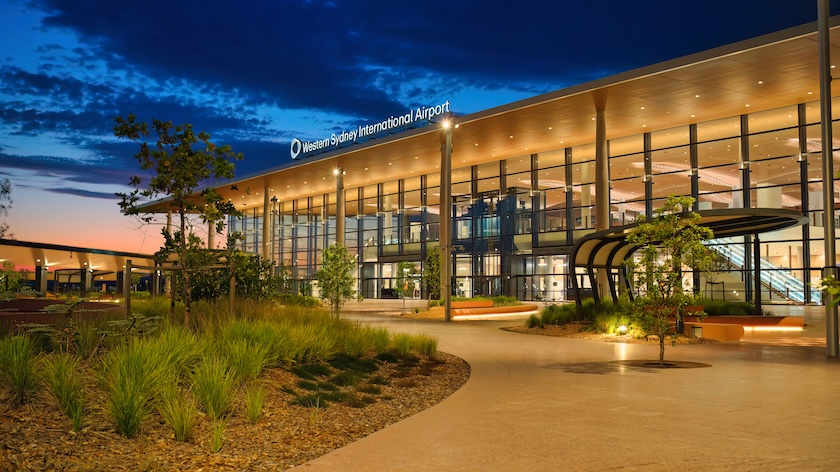
The Western Sydney International Airport demonstrates an innovative approach to airport design and operational efficiency, writes Christopher Rees.
The growing demand for air travel in both the passenger and cargo sectors is affecting the efficiency of many airports worldwide. Expansion of existing facilities is not always possible due to an airport’s location and layout. In addition, some airports have night-flying curfews that would need to be lifted to gain extra capacity.
Sydney’s Kingsford Smith Airport is a case in point. Opened in 1920, it is one of the world’s oldest operating airports. While there have been many upgrades and several runway additions since the 1960s, the most recent in 2005, current demand exceeds capacity. In the main, this is due to the night curfew and limits placed on aircraft movements, with a strict slot system that allows only 80 take-offs and landings per hour.
The airport is barely 8km from the Sydney CBD and the slot system was introduced to minimise noise and environmental impacts on densely populated suburbs around the airport.
The idea of a second airport dates to the 1940s, but it wasn’t until 1962 that it was debated by government. However, as an additional runway was being introduced at Kingsford Smith Airport, it was deemed air travel was not at a level that justified further investigation.
Then in the 1980s, with demand steadily growing, the Australian Government purchased land at Badgery’s Creek, Western Sydney, for a new airport. The greenfield site, 61km from the Sydney CBD, provided an opportunity to design an innovative, sustainable airport, providing long-term employment in the aviation, logistics and business sectors. It was envisaged the project would attract new businesses to the surrounding area and initiate growth in industries such as freight and warehousing, distribution centres, servicing and hotels.
Planning and design for the new airport commenced in 2014 and construction began in 2018.
LIFT OFF
On 24 July 2026, Western Sydney International (Nancy-Bird Walton) Airport (WSI) officially opened with its inaugural commercial freight flights taking off from its state-of-the-art, 24-hour cargo precinct. Stage one of the precinct covers approximately 733,000 square metres and will be able to cater for eight 747/777 freighters or 16 737/A320 domestic freighters, simultaneously.
Passenger flights are scheduled to begin in October. From 25 October, Jetstar will operate up to 14 flights a week between WSI and Melbourne, four weekly flights to the Gold Coast and three weekly flights to Brisbane. Jetstar services will be on Airbus A320 aircraft that can accommodate up to 188 passengers. From 28 March 2027, Qantas will operate four flights a week to Brisbane and four flights a week to Melbourne. The services will be operated by QantasLink Embraer E190 aircraft that can accommodate about 95 passengers.
The first international service will begin on 26 October with Air New Zealand scheduling three flights a week between WSI and Auckland.
WSI airport will be one of the first Australian airports to operate 24/7.
SUSTAINABILITY
WSI will operate on 100 percent renewable energy. It’s initial rooftop solar has the capacity to produce 4.5MW, enough to power about 40 percent of the passenger terminal. An additional rooftop solar energy system at the cargo precinct will generate 9MW and a 120MWh battery storage system is planned for delivery in late 2027. Additional renewable electricity will be purchased from the grid.
Ground support equipment, baggage trackers, cargo loaders, belt loaders and push-back vehicles will operate almost entirely on battery-electric power. For maximum flexibility, the ground support fleet will be centrally managed rather than ground-handling companies operating their own vehicles. The dispatch of vehicles will be based on live flight data, ensuring rapid departure and baggage off-loading at aircraft docking.
Other sustainable initiatives will include the use of recycled wastewater from the site’s own wastewater treatment facility. In addition, rainwater will be captured and added to the recycled water for non‑potable use.
Recycled materials were used during terminal construction where the design allowed, reducing the amount of waste sent to landfill.
BAGGAGE HANDLING
The airport’s Vanderlande baggage-handling system is highly automated throughout the terminal, with robotics in key areas. Each bag is placed in a single tub, and the digital system allows customers to continuously track their baggage via an airport app. The revolutionary Tubtrax system moves bags through the terminal at high speed and works in conjunction with the Adapto Bagstore. Currently, this system is not in use at other Australian airports.
Traditional systems generally sort bags at the loading area to coincide with the departure time. The new system will batch bags at the loading area through the Bagstore and make them available for flights much earlier in the process. The aim is to get bags to the aircraft more quickly, reducing aircraft turnaround and handling time. The process should also reduce the risk of lost or damaged bags.
TERMINAL DESIGN
The passenger terminal has been designed to minimise stress for passengers, maximise natural light and provide easy-to-follow, intuitive signs to help passengers reach their gates. The check-in and bag-drop stations can be used by all passengers regardless of airlines. This will help reduce passenger wait times and queues.
International and domestic flights are contained within the one terminal, reducing walking distances and speeding up transfer times. Swing gates and automated aerobridges will be used rather than rigid, single-purpose or redundant docking infrastructure. This will allow aircraft docking gates to be assigned to both international and domestic arrivals, with domestic and international passengers directed along specific routes through the terminal. This will allow a quicker turnaround of incoming aircraft.
AIR TRAFFIC CONTROL
One of the many unique features of the airport is that it will not have a traditional air traffic control tower. Instead, it will rely extensively on digital technology to provide controllers with real-time information. High-resolution cameras are positioned around the airport in strategic areas to provide a comprehensive view of the airport and immediate airspace. The live feed is transmitted to a remote centre where all aircraft movements can be monitored and controlled.
The innovative system known as the Digital Aerodrome Service will include infrared night vision, higher-resolution imagery, tracking and information on an aircraft’s speed and altitude. The system also allows controllers much improved visibility across the entire airport, eliminating blind spots that can be apparent from a control tower.
FUTURE GROWTH
The WSI master plan is based on two stages: the first to 2030 and the second to 2045. Initially, the airport has been built with sufficient capacity to handle 10 million passengers per year, along with all the associated services. The 10 million target is not expected to be reached for several years, by which time 8,500 jobs are expected to have been generated.
Stage one also includes the introduction of the Sydney Metro – Western Sydney International Airport. New roads have already been upgraded, and the new 16km M12 toll-free motorway links the airport to Sydney’s motorway system.
The airport layout has been designed to accommodate expansion as demand grows, including terminal expansion, increased aviation facilities, commercial operations, logistics and broader infrastructure.
WSI is likely to become a major transport hub, with planned expansion to meet future demand in both the passenger and cargo sectors.