
A performance edge
With plans to invest some $7 billion in UAS over coming years, Defence is pursuing an asymmetric advantage, both in cost and capability, writes Gregor Ferguson.
At the start of July, Defence deployed an Aladdin cargo drone for the first time from the rear ramp of a C-130J Hercules in flight over Cultana Training Area, South Australia. The size of a wheelie bin, the Aladdin, which is made by Adelaide-based Sovereign Propulsion Systems (SPS), is an uncrewed aerial system (UAS) capable of delivering up to 35kg of critical payloads over a 5km range from its drop-off point. And it can do this with pinpoint accuracy
to a designated spot on land or the flight deck of a moving frigate or patrol boat
in Sea State 4.
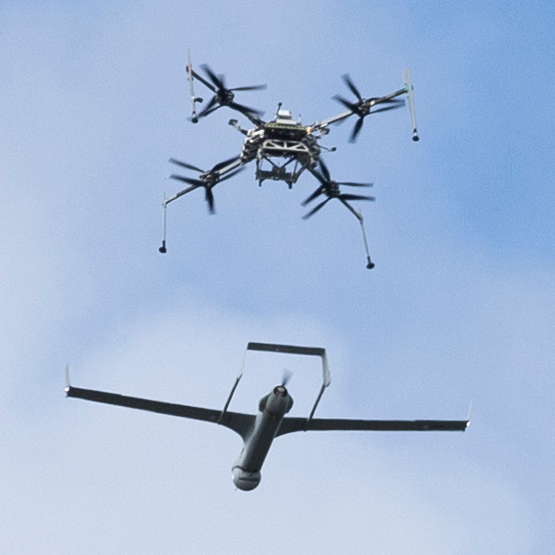
The Aladdin looks like a conventional quad-rotor drone, but it has eight rotors arranged in pairs, rather than four, and a capacious cargo bay. Aladdin project manager, Wing Commander Paul Day, says it’s a more precise way of delivering something from an aircraft when you need a method more accurate than a parachute.
While Aladdin is not a world first, it does put Australia among the world’s leaders in this technology.
Exercise Jericho Dawn, which takes place almost every year, saw Aladdin deployed from the ramp of a Hercules at an altitude and speed typical of a Hercules on an airdrop mission. Aladdin is configured to carry anything that fits into its cargo bay: spares, medicines, communications equipment, anything that service personnel might need at sea or in a contested environment.
The officer in charge of Exercise Jericho Dawn, Wing Commander Keirin Joyce, says the exercise existed to challenge conventional approaches and rapidly explore solutions to emerging capability needs.
“Aladdin brings a whole range of new capabilities to Defence and potentially into the civil sector for search and rescue, disaster relief, military resupply, tactical resupply and support to land elements,” he says.
The trial also confirms that Defence is learning the lessons from ongoing conflicts in Europe and the Middle East. It plans to invest some $7 billion in UASs over coming years, more than twice what it planned for just a year ago. Defence is already using UASs such as the Boeing Insitu RQ-21 Integrator, the Quantum Systems Vector, and the SYPAQ CorvoX, informed by their experience with the Ukrainian Army on Operation Kudu in Europe.
Brisbane-based Quantum Systems is typical of new-generation UAS manufacturers. Its Munich-based German parent company is just 10 years old, but is already worth some US$9 billion (about $12 billion). Early last year, it launched Vector AI, the latest version of its electric vertical take-off and landing Vector UAS, which is already proven in Ukraine. Vector AI’s payloads are the smartest things about it and include autonomous AI-driven intelligence, surveillance and reconnaissance, and it is hardened against GPS and communications denial.
Quantum Systems has factories in Ukraine, as well as in Australia, Romania, Lithuania, the UK and the US.
However, Defence is not doing what many urge, which is to simply copy what they see. Instead, it is pursuing asymmetric advantage, both in cost and capability, and two of the major drivers of this approach to UASs are the RAAF’s Jericho Disruptive Innovation and the Vice Chief of Defence Force’s Advanced Strategic Capabilities Accelerator (ASCA), neither of which talk much about their plans.
The RAAF’s Jericho Disruptive Innovation reports directly to the Chief of Air Force (the current VCDF, Air Marshal Robert Chipman, was the first Head of Jericho some years ago) and its job is to identify capability gaps and opportunities and pursue them. ASCA seeks capabilities that offer asymmetric advantage, for which an assured pathway to service exists, and that can then be acquired by the Defence Delivery Group and brought into service quickly.
Asymmetric advantage means different things to different people. In Australia’s case, geography is key: the country is roughly 4,000km wide and about 3,200km from north to south. In search and rescue terms, Australia is responsible for about one tenth of the earth’s surface, and its vital interests stretch well beyond this into all the sea areas surrounding Australia.
So range and speed matter, whether you are controlling a surveillance drone, launching a loitering munition or trying to intercept and destroy one. The ability to spot all of these UASs and build a comprehensive picture of their movements is also vital, and made more difficult by distance.
Cost-capability trade-offs exist in the UAS world. A long-range, high-speed UAS that can operate over significant distances on land and offshore with a man on the loop is probably attritable and costs much more than a short-range, battery powered civilian drone with a camera, which might be considered disposable. But the former may be necessary for surveillance, strike and logistics across Australian distances, while both can be replaced far more quickly and at much lower cost than an expensive, manned tactical jet.
Aladdin was part-funded by Jericho, as have been a number of other UAS projects, both large and small. Most of the rest have been funded by ASCA. Neither has disclosed the full range of missions and studies they are funding, but in the projects they have disclosed they are moving remarkably quickly, as befits organisations devoted to innovation.
One of Defence’s major counter-UAS (C-UAS) projects has been given a great deal of publicity. Project LAND156 is Defence’s counter small UAS (up to 25kg) program and ASCA has run at least one mission so far designed to equip the program with C-UAS capabilities.
Project LAND156 got under way in 2024, after some three years of research and development, and prototyping worth an estimated $58 million, with two lines of effort. The first was the appointment of Leidos Australia as strategic integration partner and the second was an initial wave of contracts, worth $38.7 million, to 20 vendors, including 14 Australian companies.
Leidos Australia was appointed in mid-2025 and at the same time Defence chose the Cortex C2 system, developed by Adelaide-based Acacia Systems; effectors from Canberra-based EOS Defence Systems; and passive sensors by Canberra-based Department 13.
Leidos Australia was able to demonstrate a mission-ready C-UAS capability by December and Defence announced it had added L3Harris’s Vampire laser-guided anti-UAS rocket system and Echodyne’s MESA radars to the system.
Then ASCA added to this line-up in 2026 through its Mission Syracuse by awarding $37.4 million worth of development contracts to AIM Defence for its high-power Fractl laser, to SYPAQ for its Corvo Strike interceptor UAV and most recently to EOS for its Slinger C-UAS direct fire system. The eventual acquisition of these systems will be handled by the Defence Delivery Group. Through Project LAND156, the ADF will continually upgrade and refresh capabilities to address emerging drone threats, says Defence.
Meanwhile, ASCA’s Mission Talon Strike aims to certify and qualify an Australian loitering munition, the OWL -B which is manufactured in Perth, WA, by Innovaero.
So, Defence is not ignoring lessons from Ukraine, Iran and Gaza, but it is not talking about them either, and especially not about the payloads its UASs carry. Like the payloads for its Ghost Shark and Speartooth uncrewed underwater vehicles, Defence simply refuses to discuss them. And that makes sense, because along with range and speed (where necessary), it is the payloads that generally create the performance edge of Defence’s UASs. The fact that Defence refuses to talk about them points to how important they are to the ADF.